


Perception
Everyone has AI figured out, or at least more than you do. You’ve tried everything: small pilots, big working sessions, a medley of tools, letting the teams “run with it,” building the ultimate AI marketing playbook. And still, nothing works like it’s “supposed to”. So, you keep asking yourself “Why does everyone have this AI-and content thing more figured out than we do?”.
Reality
Nobody has it really figured out.
Some are doing it better than most, even much better. But most of the organizations we work with are asking the same questions:
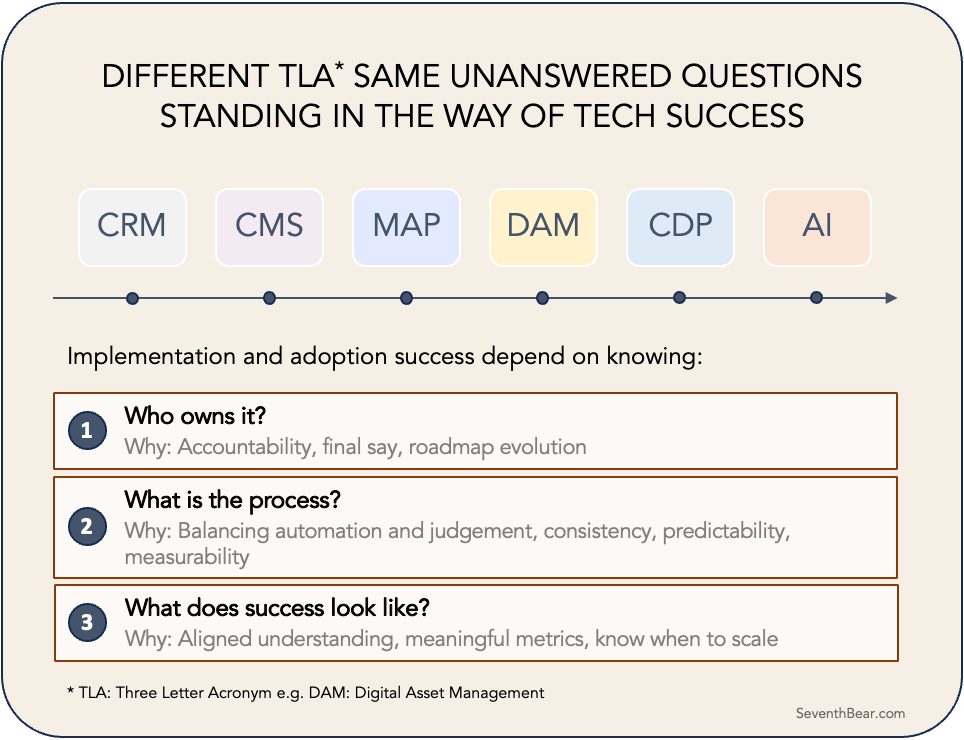
- Who owns AI?
- How do we balance what AI can do with letting the humans do the human things?
- How do we prove value for all the investment, and the time spent on trying to figure it out?
I heard those same three questions again and again in rooms full of senior marketers these last couple of weeks running workshops and speaking at lasts week’s Content Marketing World and SMASH events, which is part of what prompted this BE. These gaps are almost universal regardless of industry and size of organization.
These are not new. They’re foundational, structural challenges that have been around for as long as I have been in this industry. Just swap out “AI” for almost any other martech TLA (three letter acronym) and this conversation becomes very familiar.
Why It Matters
- The questions most teams are stuck on are more about ownership, judgement, and value, not AI.
- When teams feel the pressure to solve for something acquiring new tool/tech often becomes the quick, default move. Newsflash: technology is never THE solution without having the foundational systems in place first.
- Unless you KNOW what the company you’re comparing yourself to is really doing behind the scenes, then trying to replicate what they are doing unlikely to net you the same results you think they have.
What Most Teams Get Wrong
- Believing the highlight reel. Everyone talks about their AI wins at conferences, and (sadly) few get up on stage and share the pilot that went nowhere and what they learned from that (which was likely more than the successes).
- Treating AI as a brand-new problem instead of the same legacy, ongoing ownership, judgment, and measurement gaps just with a shorter acronym.
- Buying and piloting tech and tools before knowing and documenting who owns it, where humans stay in charge, and what “working” would even look like.
What to Do Instead
- Name an owner. Before anything else, assign/declare the one person accountable for AI across the content operation. This is apart from any committee and it’s not “everybody.” Someone has to own it to steer it.
- Decide what AI does and what humans do. Write it down, follow it, and continuously review it to make sure that the lines don’t arbitrarily drift in the name of speed and clearing the queue.
- Define success and know the value you’re looking for before you even think about scaling. If you can’t say what success is in a sentence, how can you possibly start moving towards it?
Try this with your team: Ask three of your leaders, separately, “who owns AI here?” Then compare the answers. If you get different names or versions of “well, sort of everyone,” you just found the problem. It was never that you’re behind on AI. It’s that nobody owns it, so nobody’s accountable for making it work.
Seventh Bear's Take
What’s likely holding you back from realising (more? some? any?) AI success is operational, not technological. Think about how easily you can swap in any acronym from the last twenty years and feel the exact same frustration. Answered ownership, judgment, and the value being sought from AI integration, and you’ll have a success story worth sharing with eager audiences. And when you do, don’t forget to tell them about where you tripped and what you learned too.
If you’re not sure who owns AI in your organization, or how you’d prove it was worth it, that’s not a reason to feel behind. Answering those questions is what needs to happen now, and it’s exactly where we start.
Deeper Dive
Want more on this topic? Check out: Bear Essentials: AI Isn’t Your Content Problem. Your Content Is Your Content Problem.