


Perception
You take pride in that stakeholders praise how great your team is. How responsive they are, and amazing how they can turn around content requests in what seems like an impossibly quick timeframe. That they don’t seem to have the word “no” in their vocabulary. That’s what a good marketing team does: says “yes”, delivers, keeping the business happy.
Being responsive to every stakeholder request is excellent service and makes the team a valuable partner to the business.
Reality
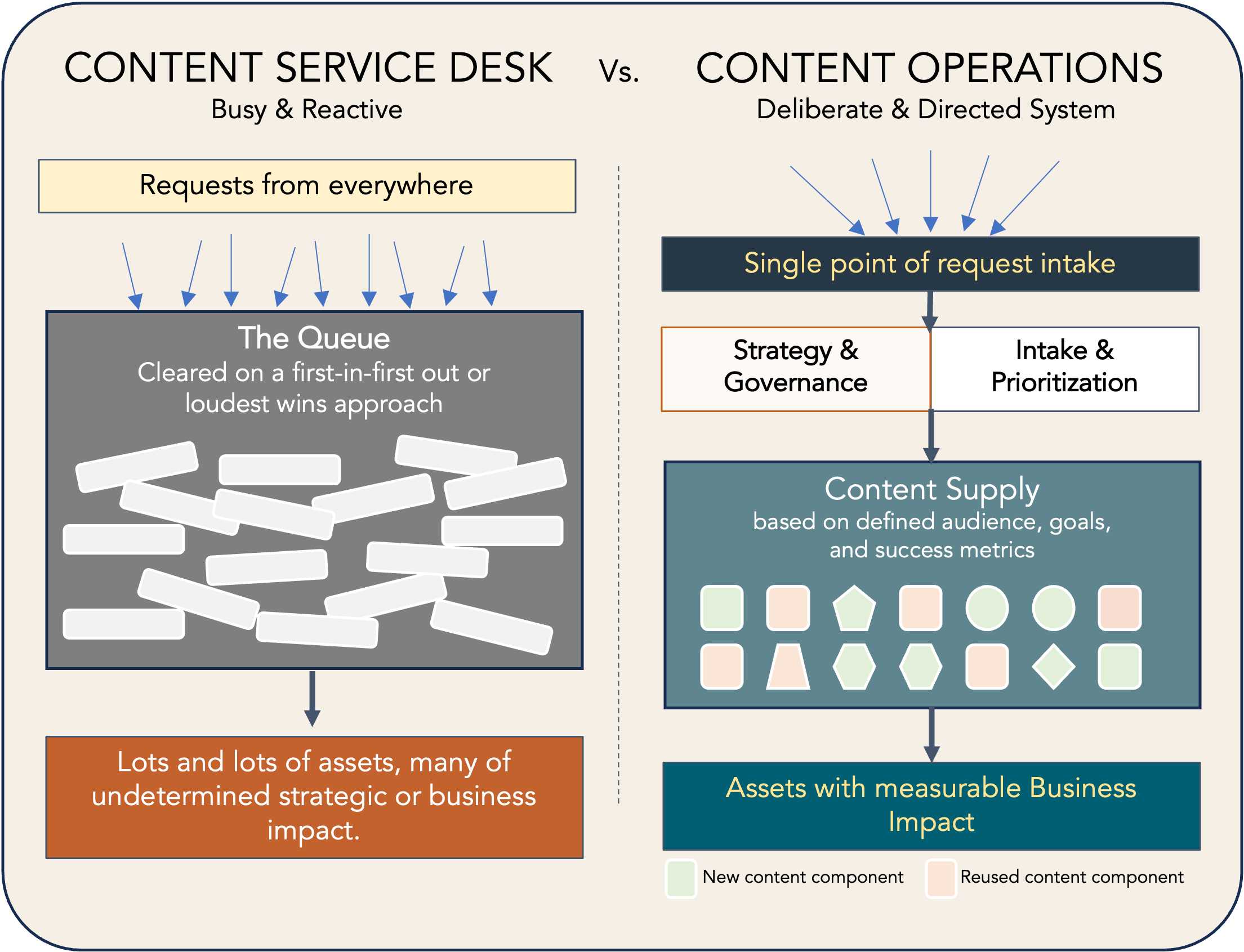
The team is acting like a service desk, and a service desk works to clear the queue, not execute a strategy.
When the content supply chain is being driven by the number of inbound requests, then it’s the one shouting the loudest who sets the priorities. No objective operating model ever gets built, let alone established. The team gets measured on turnaround time and volume rather than content quality and business impact. And responsiveness becomes the thing that stands in the way of the team being strategic.
Hyper-responsiveness has you acting on everyone else’s priorities rather than executing like the important and strategic function of the business that you are.
Why It Matters
- Budget and headcount (at an all time high it feels like) push teams deeper into reactive mode when they need to work smarter, not harder.
- A reactive team is rarely a strategic one because you can’t set direction and follow someone else’s at the same time.
- When nobody questions asks “why” a piece of content is being created, the audience ends up with volume instead of value, and they can tell.
What Most Teams Get Wrong
- Looking at responsiveness as the primary goal instead of as a signal of an efficient and effective operating model.
- Confusing busy with productive and impactful.
- Adding people to clear the queue when the queue itself is the problem.
What to Do Instead
- Create a single intake and prioritization process that EVERY content request has to go through, regardless of who is submitting it.
- Set a content strategy and evaluate requests against it, rather than letting the requests set the production roadmap.
- Assign ownership and authority to someone, giving them the power to say “no” or at least “not now” and have their decision stand. Without that authority your team are task takers not content professionals.
Try this with your team: Pull everything your team worked on in the last two weeks. For each item, ask one question: did this come from the strategy, or did it come from someone asking? If most of it came from asking, you're running more of a service desk, and it’s only if there is time left over that your actual strategy gets executed.
Seventh Bear's Take
We see it all the time: teams being “responsive” and thinking it’s a strategy. It’s not. The best content teams are the ones that make purposeful content decisions based on defined audiences, goals, and success metrics, and have built an operating system that protects those decisions from the flood of never-ending requests.
A service desk can't do strategic work, no matter how fast it runs. That's a fixable problem, and it's exactly where we start.
Deeper Dive
Want more on this topic? Check out: Bear Essentials: "We Just Need More People" Is Almost Never the Answer.