


Perception
You hate the term Content Supply Chain. Writers, graphic designers, photographers, copy editors, … are creatives; artists, not factory workers. They bring ideas and vision to life that represent the brand and products in unique and memorable ways. Without them everything is beige and the same vanilla as everyone else. It’s a craft, not a conveyor belt. So, the term doesn’t convey what we do.
Reality
It’s true, many non-marketers/creatives/content professionals read an engaging email or see a great design and think “I could do that”. These same people don’t understand why they don’t have the requested email copy in their inbox 48 minutes after they asked for it (probably because they haven't had to do it, and your team makes it look effortless). The business may not understand the process or professional-level talent it takes to create content components and turn them into memorable and impactful assets. So call it what you want, it’s still a supply chain.
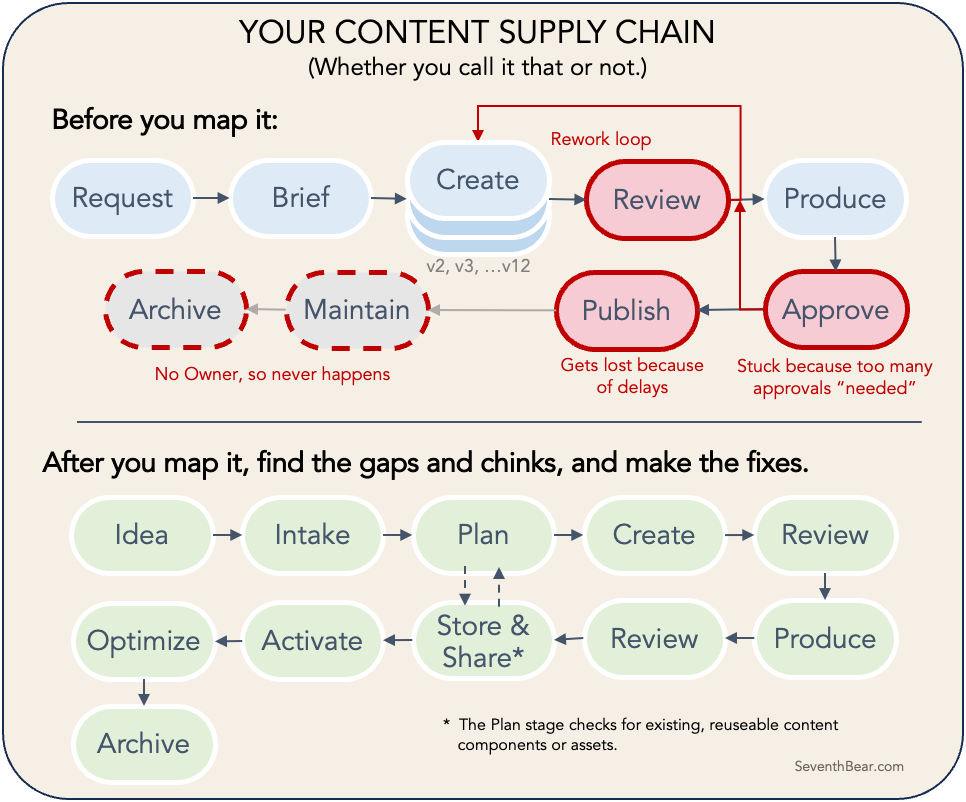
Every piece of content that is created moves through a chain: idea, request, brief, create, review, produce, approve, publish, maintain, and eventually retire. Whether or not you’ve mapped it, and regardless of what you call it. That’s a supply chain, and it isn’t diminished by calling it so.
And when you’ve never mapped it, let alone formalized it, you can be sure the chain is full of unseen and unwanted activities and stalls. Common things we uncover for clients are things like work sitting in a queue (or multiple queues) waiting on someone, the same asset getting rebuilt because nobody could find the first, or second, or tenth version of it, three rounds of review that add nothing but delays, and handoffs where things quietly fall to the floor. Your team is plenty creative but are being tripped by broken chain links.
Manufacturing sorted this out decades ago by understanding the process first and then looking for chinks or breaks in the chain that slow things down, or worse, bring the flow to a halt. Content works the same way, different, but the same. The jam is just invisible, because nobody ever drew the line.
Why It Matters
- You can’t fix what you don’t see. The inefficiencies and logjams are most often in the transition stages like handoffs and queues, not in the writing, and those are the links that nobody owns, so nobody’s seeing that they need fixing.
- No part of the process prompts anyone to look for content reuse opportunities so every idea turns into an exercise in reinventing the wheel. The same asset gets built from scratch over and over and over again because there’s no visibility into what already exists, or where it exists.
- The invisible costs of not fixing the chain are compounding. Nobody tracks wait time or rework, so it never lands in a report, so it doesn’t get questioned, and you are left wondering why your budget isn’t going as far as it used to.
What Most Teams Get Wrong
- Blaming the output (“the content isn’t good enough, isn’t fast enough”) when the real problem is the process behind it.
- Trying to fix speed by adding people or tools to a chain nobody has mapped, and is broken, makes the mess messier.
- Treating every idea as a one-off creative act, instead of something that flows through a repeatable system with knowable, fixable bottlenecks.
What to Do Instead
- Map the content supply chain; draw it, every step from ideation to intake to archive. Note where work waits, where it loops back, and where it changes hands. The chinks and missing links are easy to see when they’re drawn out on paper.
- Look at handoffs and transitions first, that’s where content often gets lost. Things like waiting for approvals, moving between teams, and creating the same content from scratch, again, because the earlier versions couldn’t be found. Fix the seams before you touch the steps.
- Pay attention to internal metrics as much as you do external metrics. How long does a piece sit between steps? How often does the same/similar thing get made twice? Those two numbers tell you more than your publishing volume ever will.
Try this with your team: Pick one recent piece of content and trace its whole journey: where the idea came from to its intake through every touchpoint until it went live (and note if if has an owner that will decide when it should be updated/archived). Write down every step and it’s duration; every person who touched it, and every place it sat waiting on someone. Most teams are surprised by how many hands it passed through and how much of the GTM timeframe the project sat in stasis waiting for the next work effort to happen. The gap between working and waiting is your supply chain telling you exactly where it hurts.
Seventh Bear’s Take
Content isn’t a factory, and I’m not suggesting you run your writers like a production line. But the work still moves through a system, and a system you’ve never mapped is a system you can’t manage or improve. The best content teams have done the unheralded work of figuring out how the work actually flows, fixing the parts that were costing them time, effort and money, and then continuously looking to improve the process so that creators spend more time creating.
Want to understand how your content is REALLY getting out the door, and how to get it there faster while improving the quality? We can help.
Deeper Dive
Want more on this topic? Check out: Bear Essentials: Everyone’s Shipping. Nobody’s Operationalizing.