


Perception
Your team is cranking out content like a machine. Literally.
All the tech and tools are finally making content easier to create and assets faster to produce, helping get content out the door in less time while being visually and grammatically cleaner. You're finally keeping (mostly) up with demand, and the work looks polished when it goes out the door.
It feels like a win, but our engagement, trust, and brand recognition metrics are flat or falling.
Reality
Efficient isn't the same as different.
When everyone is prompting the same tools with similar inputs, sure your output is speeding up, but with every asset your brand is being watered down. Like the frog in the pot, your tone and voice is slowly melting and converging with every competitor who's using the same shortcuts you are. AI-assisted content sounds robotic and mechanical because that is all AI can produce. It’s a machine, so what did you expect?
And that’s a problem, but not THE problem. The real problem is that we, the humans, have started writing the same way. In a sense, AI is (re)training us to be more like them.
AI didn't create that gap, the gap’s just gotten bigger because AI made it faster, easier, and cheaper to flood the funnel with more of its generic output. We’ve reduced the team to hiring/keeping those with who can do the most “things” for the least amount of money. Gone are the keepers and protectors of the brand voice, roles like:
- Content Strategists who define and manage the overarching brand messaging framework, voice guidelines, and content governance rules.
- Copy Editors who review, polish, and approve content across platforms acting as the brand’s quality gatekeeper, making sure every asset holds to the style guide, vocabulary rules, and tone.
- Copywriters whose copy translates the brand voice into the right tone for each channel or campaign.
Disappearing with these roles and an increased reliance on generative technology, to a large extent, are the specific, true things that only you could say, which is also the thing you can least afford to lose.
Why It Matters
- The narrator has changed. Before anyone sees anything you’ve written, an AI tool has likely already answered their question about you, built from your content and everyone else's. Without your distinct voice out there for it to leverage, the machines serve up a generic version of you, accurate or not.
- Word of mouth has always been the loudest voice in the room (not your content). People trust customer reviews roughly twice as much as anything a company says about itself. That makes the part you do control matter even more.
- Trust is shifting quickly. The share of people who say heavy AI use would lower their trust in a favourite brand doubled from 20% to 40% in one year. Sounding like a machine now costs you in a currency you can't just buy back.
What Most Teams Get Wrong
- Looking at increased AI output as a quality and efficiency win while ignoring the risks to brand voice. Polished and generic is still generic.
- Thinking this is an AI problem. A missing, undefined voice is a positioning problem that has been around for years, well before AI showed up. AI doesn't fix that; it amplifies it, and produces more of it, faster.
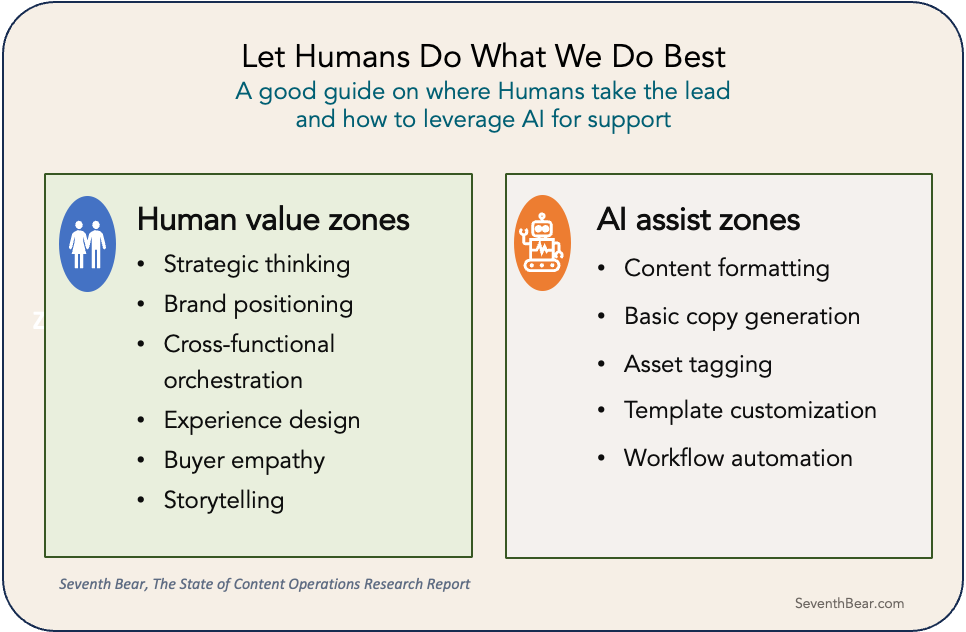
- Letting the deadline dictate how content is created. The strategy, the empathy, the storytelling, you know, all the human stuff, subconsciously slides into the AI column (see graphic below) when deadlines are piling up and demands are still streaming in.
What to Do Instead
- Build “The Rule of 3” one-page brand voice brief. Sure, keep the the 40-page PDF guideline nobody opens, but build this one-pager that will actually get used. The Rule of 3 brand brief includes:
- Three words you use and three words you never (and I mean ever) use.
- Three phrases you'd never say (the buzzwords that make you sound like every other brochure and home page.
- Three details only you can claim. These have to be specific and TRUE, and no competitor and no competitor's AI could ever invent.
- Decide where AI gets used BEFORE using it. Here's what we recommend:
- Humans lead on strategy, positioning, empathy, and storytelling.
- AI assists with formatting, first drafts, repurposing, and tagging.
Write the split down, provide examples, and share it with anyone involved in content.
- Keep a human involved with anything where a real person's trust is attached. If someone on the other end could be hurt, embarrassed, or grieved, a human writes it. Full stop. Not negotiable. Writing something that is accurate isn't the same as writing something that is okay, and AI doesn’t know the difference.
Try this with your team: Pull your last five pieces of published content, and for each one, ask a single question: could three of your competitors run this exact line without changing a word? If the answer is yes it's the category's voice not yours. Then find the one detail in each piece that only you could honestly claim. Can you? If it's difficult for you, it's near impossible for your audience to see how you're different.
Seventh Bear's Take
Tools are never a strategy, and AI is just another tool. The brands that stay distinct are the ones that did the unglamorous foundational and positioning work first: decided what they actually sound like, and what only they can say, before they handed the keyboard to a machine.
If you're not sure what makes you sound like you, or where AI belongs in your operation and where it doesn't, you're not alone. But it is one of the most important things to sort out ... now! And we can help.
Deeper Dive
Want more on this topic? Check out: Bear Essentials: Your Voice and Tone Aren't Guidelines, They're Discipline.